Sciatica Treatment Charlotte: Why the Pain Keeps Coming Back


Somewhere between “take these and come back in six weeks” and “here’s the surgical consent form,” a lot of Charlotte patients fall through a gap that costs them years of unnecessary pain.
They leave their orthopedist’s office believing surgery is the only path forward. In most cases, it isn’t.
We’ve been treating complex spinal injuries in Charlotte since 1997, and one of the most common things we hear from new patients is some version of: “I wish I’d known this existed before I agreed to the surgery.”
This post is for anyone who’s been handed that surgical recommendation and isn’t sure what to do with it.
Why Doctors Recommend Back Surgery
To be clear: sometimes surgery is genuinely necessary. A severe spinal cord compression, a fracture, progressive neurological loss — these may require surgical intervention.
However, the majority of spinal surgeries performed in the United States each year target conditions that respond well to conservative, non-surgical care. Discectomies, laminectomies, spinal fusions — these procedures carry high rates of repeat surgery and significant rates of what’s called “failed back surgery syndrome,” where pain continues or returns after the operation.
The core problem is that most orthopedic surgeons aren’t trained in — or financially incentivized to offer — non-surgical alternatives. So when a conservative approach fails (physical therapy, injections, pain management), the surgeon presents surgery as the logical next step.
But there’s a step that almost never gets offered: advanced non-surgical spinal decompression.
What Spinal Decompression Actually Does
The DRX9000 is the most advanced non-surgical spinal decompression system available. Using computer-controlled distraction, it gently elongates the spine and creates negative intradiscal pressure — essentially a vacuum effect inside the damaged disc.
This produces two important results.
First, it draws herniated or bulging disc material back toward its normal position, reducing pressure on surrounding nerves. This directly relieves pain, numbness, and radiating symptoms.
Second, it promotes blood flow and nutrient exchange into the disc — a structure with very poor circulation on its own. As a result, the disc’s natural healing process gets real support.
Most patients lie comfortably on the DRX9000 table for about 30 minutes per session. No needles, no anesthesia, no recovery time.
The Conditions That Respond Best
Spinal decompression has strong clinical evidence for:
One of our patients, Jacque Maus, arrived with pain she described as a 10 out of 10. “It hurt to walk, sit, sneeze, or do anything that required movement to my back.” After her first DRX9000 treatment, her pain dropped to a 3. Within a few days, it was gone entirely.
That kind of result isn’t typical of every case — but it’s not rare either.
Why Chiropractic and Functional Medicine Matter Too
Decompression works best as part of a comprehensive strategy, not as a standalone treatment.
The disc doesn’t become herniated in a vacuum. Years of spinal misalignment, poor movement mechanics, and sometimes systemic inflammation all contribute to disc breakdown. Consequently, if you decompress the disc without addressing those underlying drivers, the problem is likely to return.
At Innovation Health, we integrate non-surgical spinal decompression with chiropractic adjustments (to restore proper spinal alignment), custom orthotics (to correct gait mechanics that continuously stress the spine), and — when needed — functional medicine protocols to address the inflammatory and metabolic factors that slow healing.
This integrated approach produces lasting results, not just temporary relief.
Should You Get a Second Opinion?
If you’ve been told you need back surgery and haven’t yet explored non-surgical spinal decompression, the answer is yes.
Not because surgery is never the right answer. Rather, most patients who come to us having exhausted “everything” haven’t actually tried this — and it works for a meaningful percentage of them.
A comprehensive evaluation takes about an hour. We’ll review your imaging, examine your spine, and give you a clear picture of whether you’re a candidate for non-surgical care. If surgery truly is the right path, we’ll tell you that honestly.
Schedule your evaluation at ihealthnc.com or call (704) 549-3005.
Innovation Health | 8401 University Executive Park Drive, Suite 126, Charlotte, NC 28262
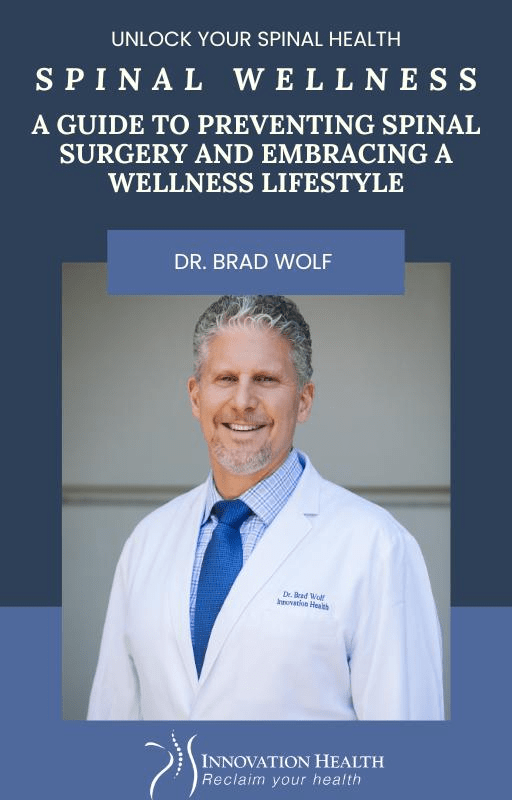
Spinal Wellness: A Guide to Preventing Spinal Surgery and Embracing a Wellness Lifestyle
Take control of your spinal health and avoid surgery with our free e-book, Spinal Wellness: A Guide to Preventing Spinal Surgery and Embracing a Wellness Lifestyle.