

Charlotte’s integrative approach to sciatica — targeting the nerve compression at its source, not just managing the symptoms.
It starts somewhere in your lower back — or maybe your glute — and then it fires. A burning, shooting, sometimes electric pain that travels down one leg. Sometimes into your calf. Sometimes all the way to your foot.
You can’t sit through a meeting. Getting up from a chair is a process. Sleeping on your side has become impossible. And the pain seems to appear out of nowhere — a certain angle, a sneeze, a moment of bending the wrong way — and suddenly you can’t think about anything else.
Sciatica is one of the most disabling types of pain people experience. And it’s one of the most commonly mismanaged.
Most patients are given anti-inflammatories, muscle relaxers, or referrals to pain management — all of which treat the symptom. None of which address what’s actually pressing on that nerve.
We do things differently.
The sciatic nerve is the largest nerve in the body. It originates in your lower spine and travels through the glute, down the back of the thigh, and into the lower leg and foot. When something compresses or irritates it — most often a herniated disc, bone spur, or inflamed soft tissue in the lumbar spine — it fires.
That “something” is what we treat. Not the nerve itself. The cause of the compression.
The most common culprits:
Until the pressure on the nerve is relieved, the pain will keep coming back — no matter how many medications you take or how many times you ice it.
Step 1: Find exactly what’s compressing the nerve. Your initial evaluation includes a detailed neurological and orthopedic examination and review of your imaging (MRI, X-ray). We want to know precisely which structure is irritating the nerve — because the treatment strategy depends on it.
Step 2: DRX9000 Spinal Decompression (if disc involvement is present). If a herniated or bulging disc is contributing to your sciatica, the DRX9000 is the most effective non-surgical tool available. It creates gentle negative pressure inside the disc, drawing the herniated material away from the nerve and allowing the disc to heal. Many patients feel relief within their first few sessions.
Step 3: Chiropractic Adjustment. Spinal misalignment is both a cause and a consequence of sciatica. Precise chiropractic adjustments restore normal joint mechanics, reduce nerve irritation, and take pressure off the structures that are firing the sciatic nerve.
Step 4: Soft Tissue & Therapeutic Work. Tight, inflamed muscles — particularly the piriformis — can entrap the sciatic nerve independently of any disc problem. We address this as part of the overall strategy.
Step 5: Custom Orthotics & Gait Correction. The way your foot strikes the ground affects everything above it — including your lumbar spine. Faulty gait mechanics can continuously re-stress the same spinal segments. Custom orthotics built from individual foot scans remove this cycle of re-injury.
Discover the journeys of those who’ve embraced a new chapter in health. Your story of wellness begins here
"Before coming to Innovation Health, I had a limited range of motion and was in a lot of pain. Now I walk with more confidence and have less low back and leg pain. My mid-back pain went away entirely."
"My pain was unbearable — a 10 out of 10. It hurt to walk, sit, sneeze, or do anything that required movement to my back. After one DRX9000 treatment, my pain dropped to a 3. A few days later — completely gone."
"My problem was so bad I could barely walk. It was painful to sit for long periods and very difficult to get in and out of the car. Innovation Health has been the problem solvers."
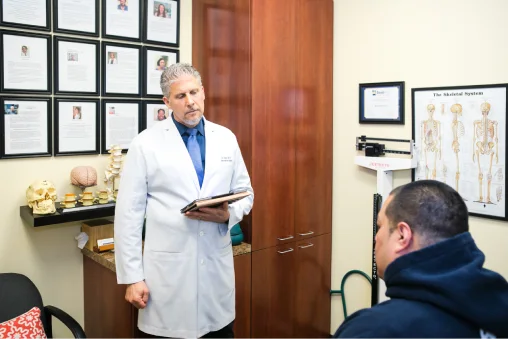
"Dr. Wolf did a very good job explaining the problem and had a solution."
Dr. Brad Wolf, DC has specialized in complex spinal injuries in Charlotte since 1997. His combination of chiropractic care, DRX9000 decompression, and biomechanical correction has helped hundreds of local patients resolve sciatica that other providers couldn’t.
Many patients experience meaningful improvement within 3–6 treatment sessions. A full resolution typically takes 6–12 weeks depending on the underlying cause and how long the condition has been present.
Not necessarily. If you have one, bring it — we'll review it as part of your evaluation. If you don't, Dr. Wolf can assess your case clinically and order imaging if needed.
Sometimes a mild acute episode resolves with rest. Chronic sciatica — pain lasting more than 6–8 weeks — rarely resolves without addressing the structural cause.
No. Our goal is resolution, not dependency. Once the underlying compression is addressed and structural stability is restored, most patients need only periodic maintenance care.
Serving Charlotte, Huntersville, Concord, Belmont, Indian Trail, Denver NC and surrounding areas


Spinal Wellness: A Guide to Preventing Spinal Surgery and Embracing a Wellness Lifestyle
Take control of your spinal health and avoid surgery with our free e-book, Spinal Wellness: A Guide to Preventing Spinal Surgery and Embracing a Wellness Lifestyle.
— Cheyhene Miller, Huntersville NC